What’s at Stake
In a community of over 15,000 adults and 5,000 children, we must ask: Would an expanded sailing center serve the broader public—or would it restrict access to those who simply want to fly a kite, walk along the harbor, read, paint, fish, picnic, or simply breathe?
The health and well-being of our community depend on equitable access to open space. Charlestown already faces elevated rates of asthma, heart disease, and lung illness. In a time of overlapping health and climate crises, the BPDA’s disregard for environmental and public health consequences is both short-sighted and dangerous.
It is harmful to build housing on toxic land, in flood zones, or in polluted air—as proposed at the Austin Street lots. It is harmful to cut down 288 mature, century-old trees at the Bunker Hill Housing site. It is harmful to hand over public waterfront to private equity developers. It is harmful to ignore the community.
Why it Matters
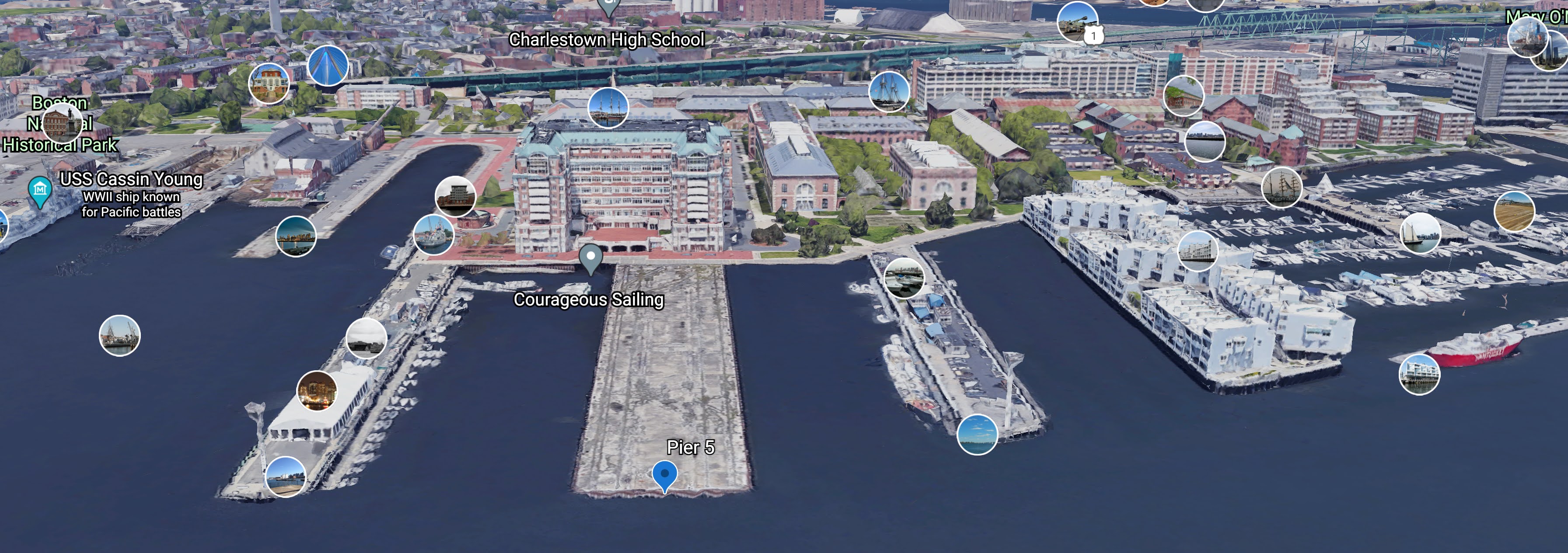
Pier 5 in the Charlestown Navy Yard: Why Does It Matter?
There is a great deal of uncertainty in the U.S. economy with rising energy costs and
inflation, and our city of Boston is grappling with a host of issues such as homelessness,
affordable housing, the public schools and drug addiction to name some of the most
pressing. These are critical issues that are major determinants of an individual’s quality
of life and the health of our city as a whole. They all compete for funds from the city’s
budget and the time, focus and attention of our public officials.
So, in this context, why should the plight of abandoned Pier 5 and the community’s
desire to create an open space park here matter?
During the pandemic, we learned quite a bit about the benefits of the outdoors and
physical and mental well being that open spaces can provide. And, in trying financial
times, even a trip to New Hampshire’s lakes can be a struggle for the average Boston
family. An open space park, especially one that is waterfront facing, provides benefits
to individuals, families and the city as a whole.
The City Parks Alliance (www.cityparksalliance.org), a Washington, D.C. based
membership organization solely dedicated to urban parks with a focus on improving
community health, just released a report that supports investments in city parks for
health, economy and the environment. According to the report, urban parks are
becoming recognized as a powerful tool for urban communities and local economies.
The report indicates that people with access to safe parks exercise more and have lower
rates of obesity, heart disease and diabetes. People who live near parks and green
spaces are 44% less likely to have a diagnosed anxiety order. Twenty minutes in a park
improved the concentration of children with attention deficits. These are compelling
statistics that are just coming to light in the aftermath of the pandemic; public policy and
decisions on spending public funds are behind the curve of this research. In Boston, our
city budget allocates less than 1% of the total budget on parks spending. As the general
population and elected officials become more aware of the health benefits of public
parks in urban environments, this percentage should rise, not just in Boston but in many
major metropolitan areas throughout the country.
Politicians have taken on the cause of access to open space and the waterfront in
particular as part of their social justice platforms. Boston’s Mayor Michelle Wu was
quoted as saying “As a coastal city, we need to get our waterfront right — by centering
equitable access, climate resilience and community”. Further, our city’s Chief of Open
Space and the Environment, Reverend Mariama White-Hammond stated: “We are trying
to embed equity in everything we do in the way that we make decisions…..Every single
person in the city of Boston should see the water as part of their experience as a
resident.”
Charlestown is the oldest settled land in Boston and has among the highest population
density among city neighborhoods. It has one of the lowest amounts of open space in
the city at 3.09 acres per 1,000 residents (compared with over 5 acres in East Boston
and 7.59 acres for the City as a whole). Charlestown ranks third in the amount of incomerestricted
housing units in the city and is home to the largest public housing development
in the Northeast, Bunker Hill Housing Development, a stone’s throw from the Navy Yard.
A public space at the Pier 5 location would provide an opportunity for more
neighborhood crossover and an attraction for all residents of Charlestown to enjoy as a
harborfront park.
Charlestown, bisected by the Tobin Bridge and Route 93, has one of the highest asthma
rates in Boston while our tree canopy, a proven tool for alleviating asthma, is the lowest
in the City at 11% and is under further threat of more destruction from new development.
Slated expansion of the Bunker Hill Housing Development as well as other proposed
large developments throughout the city of Charlestown will add and estimated 11,000
new residential units to our current population of 19,120. (This, on top of a 16% growth
in population from 2010-2020 compared with 9% for Boston.) The need for open space
is evident.
In addition to health and recreational benefits, as one of the few remaining open spaces
on the Boston waterfront, Pier 5 represents a once in a lifetime opportunity to create an
iconic open space park in a historic area which attracts school groups, visitors and
tourists to see the USS Constitution and Bunker Hill. The site where Pier 5 now sits is
where the British lobbed bombardments to start the Battle of Bunker Hill and the
American Revolution. Every year, over a half a million people visit the USS Constitution
and 4 million people traverse all or part of the 2.5 mile long Freedom Trail which covers
more than 250 years of history and 16 nationally significant historic sites that tell the
story of the American Revolution and beyond. Pier 5 could represent a finishing point to
the Freedom Trail and its history and a capstone to a visit to the USS Constitution. Every
historic trail should have a meaningful terminus and we have in Pier 5 the opportunity to
make a spectacular one. Once Pier 5 is ceded over to private development, the potential
and promise of Pier 5 is gone forever.
Members of our Charlestown community have stood for a historic, climate resilient public
pier at Pier 5 for over thirty years. The pier is owned by the BPDA (Boston Planning and
Redevelopment Authority) who has neglected the pier and not maintained it. They
routinely call for RFP’s (Requests for Proposals) to build on the pier despite strong public
opposition. Most of the proposals that have been floated have died under the weight of
impossible economics. A more fiscally prudent approach would be to restore the pier
to standards used for public assembly, not commercial development, and open this
area up for public enjoyment and a showcase for our history.
We have over 3,200 petition signatures asking the Mayor to create a park on the Pier 5
site. We have held three widely-attended community events that proved the allure of
gathering along the waterfront as family recreation. Other parks throughout the city are
creating many active and innovative programming events. Mayor Wu has introduced
some high energy gatherings on the Greenway, for example, that had robust attendance.
Appropriate programming emphasizing health and history will bring even more residents
and visitors to this magnificent and historic site.
Pier 5 is also critical to our history. We are approaching the 250th anniversary of the Battle
of Bunker Hill in 2025, the 250th anniversary of the start of the American Revolution in
2026 and the 400th anniversary of the founding of the City of Boston in 2030. This historic
location, so integral to our nation’s founding, should be celebrated and play a role in
upcoming commemorations.
Many have noted the cost to clean up Boston Harbor was paid for by tax payers and rate
payers with most of the benefits going to developers. Let’s return this site to the people
who paid to clean up our harbor a create a destination for all residents to enjoy. It can
be done. Look at the plans for Piers Park III in East Boston and all that it will provide for
the community. Look at Pier 26 in New York City which is a ecologically-themed park.
Help us get Pier 5 and the need for a waterfront facing park on the radar screen of our
elected officials and as a worthy candidate for infrastructure funds that are now available.
Leave a Reply