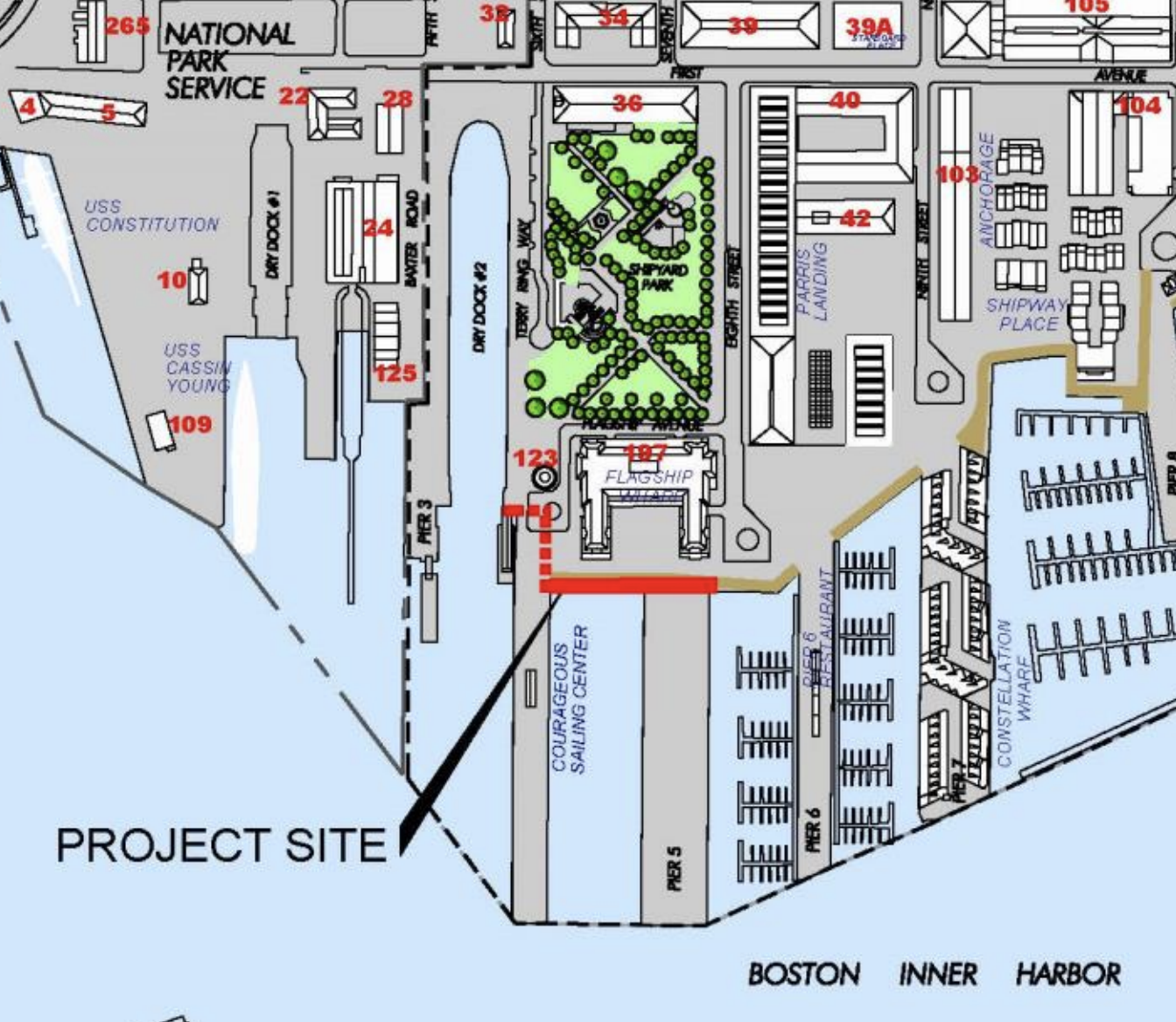
If a $2.7 million RFP for studying the area and the sinkholes surrounding Pier 5 can be put forth, it would be money well spent to put out an RFP for a second opinion on Pier 5 with a goal to rehabilitate or renovate, not destroy, focusing on supporting pedestrian loads, not commercial or residential uses.
Pier 5 is a classic case of infrastructure deterioration from long-standing neglect that is worthy of remediation. The Pier 5 Association believes that we do not have to accept demolition of Pier 5 without first exploring all options for restoration, reuse and revitalization. There is no need to destroy Pier 5.
It can be restored for lighter loads which is why Federal Infrastructure dollars for a “Reparative/Restorative” project that will return the Pier to the public as much needed waterfront Open Space and a community resource is an avenue to explore. The pier does not have to be demolished and rebuilt to hold the weight of a large development; nor does it require restoration to the original U.S. Navy standards for battleship construction. What should be considered is an environmentally responsible re-use.
The BPDA has engaged Childs Engineering, a Bellingham, Massachusetts-based firm that specializes in waterfront structural engineering to study the condition of Pier 5. Childs is a reputable firm that has worked on many piers in the Boston Harbor. Over the years, Childs has performed several inspections of Pier 5 starting in the 1980’s and has recommended repairs and maintenance which have been ignored. The most recent study on the condition of the pier was done in 2017 and delivered to the BPDA on January 16, 2018.
The original design capacity of Pier 5 was for uniform live load of 400 pounds per square foot. Over the years, Childs has offered some conceptual repairs which would be required to maintain the pier in usable condition. One approach may be to repair every third pile and perform some concrete patching or shot crete placement on the bottom of the beams and deck where the most severe deterioration has occurred. This would stabilize and maintain the facility so that it could support 100 pounds per square foot of live load which is the State Building Code standard required for public assembly. Looking at other nearby piers, Pier 7 upon which Constellation Wharf is situated has 960 pilings supporting a 64-unit condominium building. Lovejoy Wharf, located near North Station, supports a large public pedestrian space with much less pier density than any piers in the Navy Yard, especially Pier 5 which is the densest with 1,645 steel H-piles.
In their latest report, Childs was tasked only to look at demolishing Pier 5 and were not directed to look at options for the Pier that would be less costly and may allow the Pier to remain intact and functional but with lighter loads. This report found that the piles supporting Pier 5 were “completely worthless from a load capacity standpoint.” The 2018 report recommended that the problem be addressed within the next five years. A full pier demolition was estimated to cost $5 million; full pier repair including demolition and replacement was estimated at $16 million. (And we note that Childs was not asked to look into and did not delve into issues regarding structural implications on surrounding buildings and the Harborwalk if the existing Pier 5 is demolished.)
Because of its wartime construction pedigree, Pier 5 is an impressive pier uniquely designed to take unexpected and unevenly distributed weights for the repairs and maintenance of large ships. This is evidenced by the remaining railroad tracks that can be seen on the pier today. The density, and therefore the structural load capacity of Pier 5 is greater than any of the other piers around because of the thickness of the deck and the proximity of the piles to each other. That is why the cost to restore the pier to original specifications is onerous and not something we are proposing; nor is it necessary to permit safe public waterfront access.
As part of our analysis, we are exploring some conceptual repairs which would be required to maintain the pier in usable condition. It is a reason why wrapping selective clusters of piles to create fewer, bigger and stronger base supports could be one solution for its rehabilitation. Further, it may be possible to remove selective portions of the existing heavy deck and substitute modules of new materials with lighter weights. And, only making selective parts of Pier 5 traversable is an additional option.
Available engineering studies are inadequate and do not thoroughly explore the risks and benefits of alternative and creative restoration options, especially in the context of climate change, sustainable landscapes and energy neutrality. Pier restoration technology has advanced dramatically in the past decade. A feasibility study should be done to identify potential reuse. An adaptive re-use would present the most cost effective and environmentally friendly re-use of either a portion or the pier as a whole for a public park.
Creative consideration of alternative approaches to addressing the unique challenge this represents needs to occur as a priority. Risk benefit analysis weighing the hazards of abutting properties, the harbor, the rich marine environment and coastal resilience of alternative solutions and a confirmation of the urgency of intervention is needed in full details. This information should be obtained without delay. Fear of the costs described in the Childs Engineering Report have triggered a rush for development decisions without thorough examination of design and re-use possibilities or consideration of the merits of competing solutions.
Sherrie Cutler, AIA, a Charlestown resident and internationally accomplished urban planning expert and designer has commented on the Pier 5 RFP as follows:
Leave a Reply